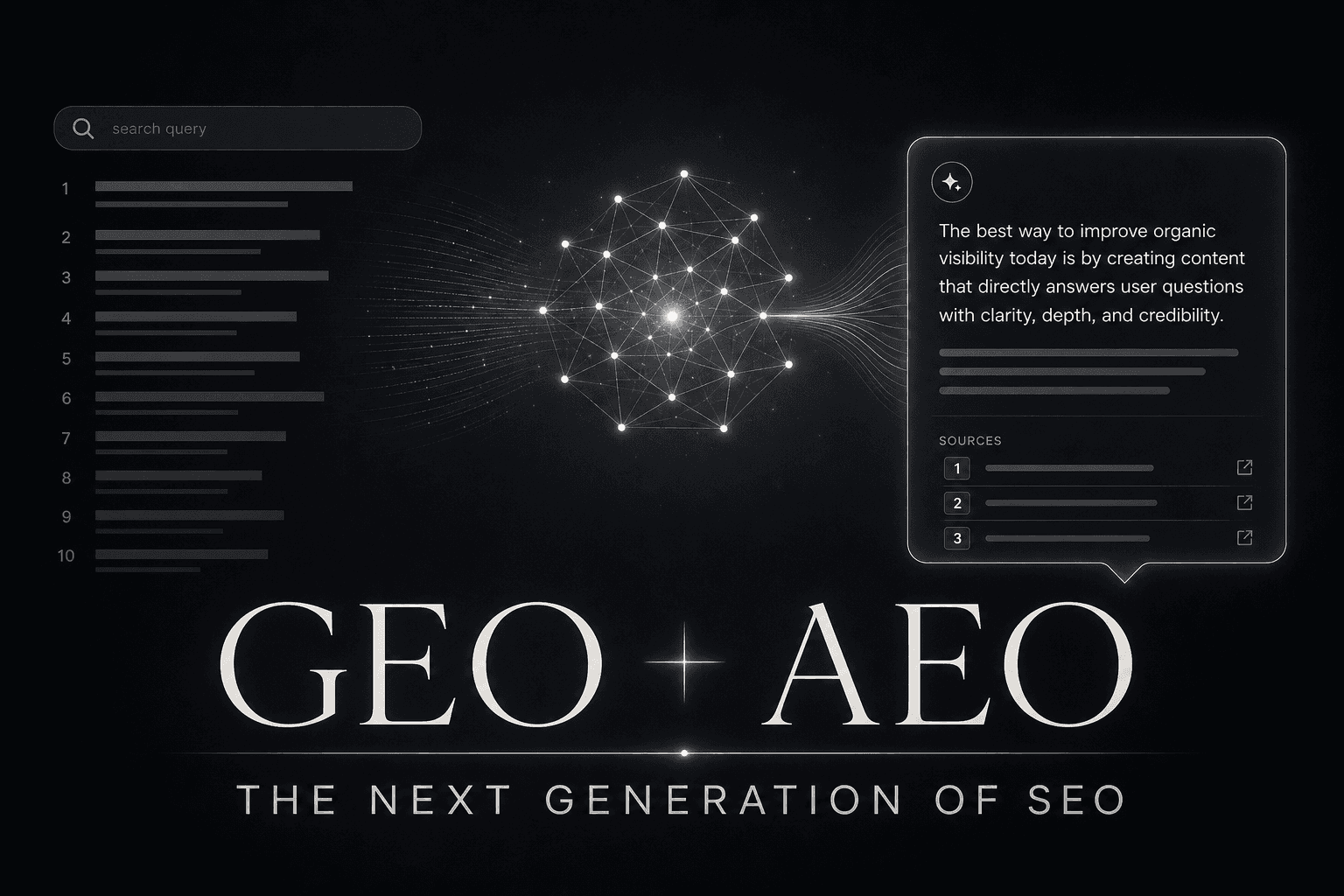
Search changed, again
For twenty years, SEO meant ranking on a results page: keywords, backlinks, technical health, and content that matched intent. That still matters, but users increasingly get answers without clicking. ChatGPT, Perplexity, Google AI Overviews, and voice assistants synthesize responses from across the web. Your brand either shows up inside those answers, or it doesn't.
That's where GEO (Generative Engine Optimization) and AEO (Answer Engine Optimization) come in. Together, they're the next layer of discoverability beyond traditional SEO.
What is GEO?
Generative Engine Optimization is the practice of making your content easy for large language models and generative search tools to find, understand, trust, and cite. GEO isn't about tricking an AI, it's about clarity, structure, authority, and factual consistency so models can confidently reference you.
Generative engines favor sources that are:
- Explicit and well-structured, clear headings, definitions, and scannable sections
- Authoritative, consistent brand signals, credentials, and corroboration across the web
- Fresh and accurate, up-to-date product, pricing, and policy information
- Machine-readable, schema markup, clean HTML, and accessible content hierarchy
What is AEO?
Answer Engine Optimization focuses on winning the direct answer: the snippet, the summary, the "here's what you should know" response. Answer engines, from Google featured snippets to AI chat interfaces, reward content that resolves a question in one pass.
Strong AEO content:
- Leads with a concise answer in the first paragraph
- Uses question-based headings that match real user queries
- Includes lists, tables, and step-by-step formats models can quote
- Covers related follow-up questions on the same page
How GEO and AEO relate to classic SEO
Think of it as three layers working together. SEO gets you indexed, AEO gets you quoted, and GEO gets you referenced when AI synthesizes an answer from multiple sources.
| SEO | AEO | GEO | |
|---|---|---|---|
| Full name | Search Engine Optimization | Answer Engine Optimization | Generative Engine Optimization |
| Primary goal | Rank in search results and earn clicks | Win the direct answer or featured snippet | Get cited inside AI-generated responses |
| Where users find you | Google, Bing, traditional SERPs | Featured snippets, People Also Ask, voice answers | ChatGPT, Perplexity, Google AI Overviews, copilots |
| What success looks like | Top rankings and organic traffic | Position zero, the answer shown without a click | Your brand named or linked in a synthesized answer |
| Content format | Keyword-targeted pages, blogs, landing pages | Concise Q&A, definitions, step-by-step answers | Structured guides, entity-rich pages, corroborated facts |
| Key tactics | Keywords, backlinks, technical SEO, page speed | FAQ schema, direct answers, question-based headings | Authority signals, schema, freshness, multi-channel presence |
| User behavior | User clicks through to your site | User may get the answer without visiting | User may never leave the AI chat window |
| Best for | Discovery and sustained organic growth | Specific questions with clear, quotable answers | Brand visibility in AI-driven research and recommendations |
Technical SEO fundamentals still apply across all three. If bots and models can't access your site, nothing else works. But ranking #1 for a keyword matters less if the user never leaves the AI chat window.
Practical steps for GEO and AEO
1. Structure content for extraction
Write pages that stand alone: a clear title, a direct summary, supporting detail, and FAQs. Models extract fragments, make every section quotable.
2. Invest in entity clarity
Use consistent naming for your company, products, and services everywhere, website, Google Business Profile, social profiles, directories, and press. Conflicting descriptions confuse both algorithms and models.
3. Add structured data
Product, Organization, FAQ, and Article schema help search and generative systems understand what you offer. For e-commerce, feeds through Google Merchant Center bridge product data into Shopping and AI-assisted discovery.
4. Publish authoritative guides
Long-tail educational content, comparisons, how-tos, glossaries, earns citations. This is especially relevant for brands selling complex products where buyers research before they purchase.
5. Extend beyond your website
Reddit discussions, YouTube, reviews, and community threads increasingly feed AI answers. A coordinated presence across channels reinforces what models "know" about your brand.
6. Measure what you can
Track branded search volume, referral traffic from AI platforms where available, impression share in rich results, and conversions from informational content. The tooling is still evolving, start with baselines now.
What this means for businesses
GEO and AEO aren't replacements for SEO, they're extensions. Brands that only optimize for ten blue links will lose visibility to competitors who show up inside AI-generated recommendations, shopping comparisons, and chat-based research flows.
At Break Project, we're already applying this stack for clients: Swell storefronts with clean product data for Google Shopping, Reddit and OpenAI ad placements, and content structured so both humans and models can find the right answer fast.
Bottom line
The next generation of search is conversational, synthesized, and often clickless. SEO gets you indexed. AEO gets you quoted. GEO gets you referenced. Build for all three, or risk becoming invisible in the places your customers now start their journey.